
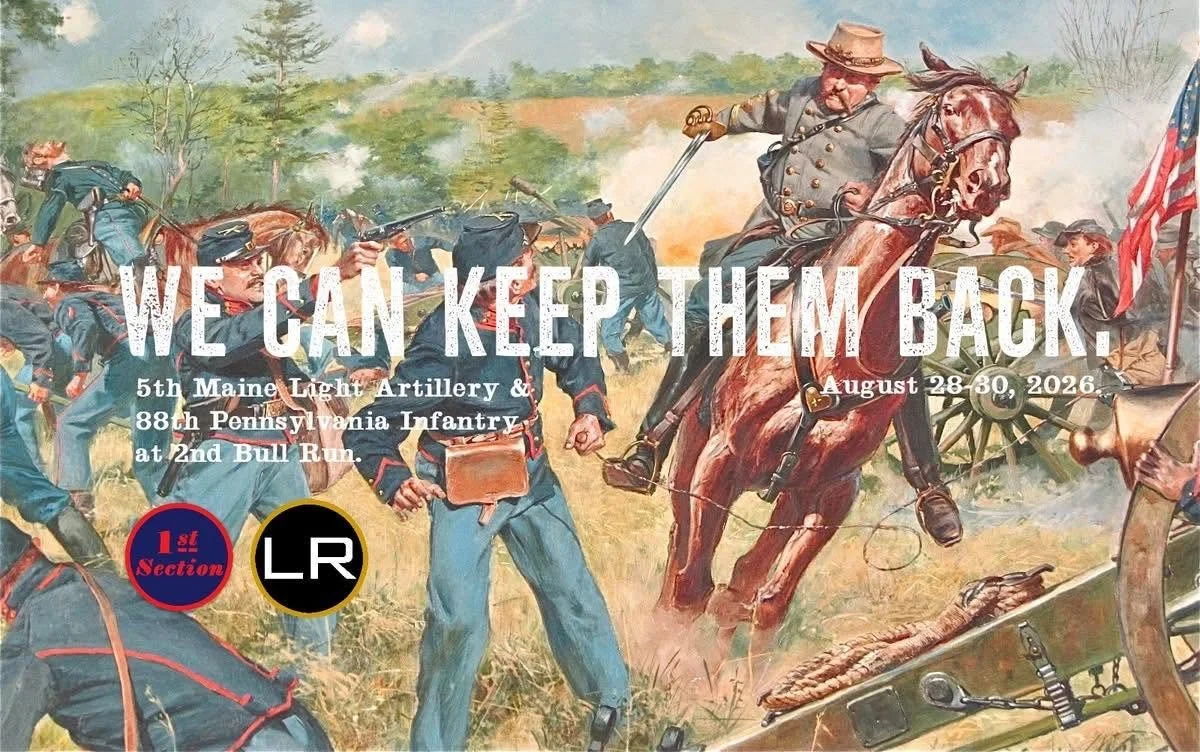
History of the 5th Maine Battery
After the defeat at 1st Bull Run, the U.S. Congress authorized the recruiting of up to 500,000 additional volunteers “to meet necessities.” In response to this, the Fifth Maine Battery was organized and mustered on December 4, 1861 in Augusta, Maine. The battery initially did several months of duty at Fort Prebble, Portland, Maine under the command of Capt. George Leppien.
It was ordered to Washington, D.C. in April, 1862. They camped on Capital Hill and were assigned to the Military District of Washington. In May, they moved to Aquia creek and subsequently to Fredericksburg where they joined the Department of the Rappahannock.
At the end of May, in response to Jackson’s movements in the Shenandoah Valley, the battery was ordered to Front Royal where they did duty until being organized into the 2nd Division, 3rd Corps, Army of Virginia in June. For the next three months, the battery would march around northern Virginia. They would arrive too late to participate in the defeat at Cedar Mountain, August 9, 1862.
Maneuvering with Pope’s retreating army, they would be used to reconnoiter and guard fords, falling back from Culpepper to Rappahannock station. On August, 20th, they would assist in the defense of the Rappahannock station railroad bridge, preventing the Confederates from gaining a position on the river and later assisting in the destruction of the bridge. This would be the battery’s first combat, but it can hardly be described as a battle.
The battery would act as a rear guard, covering the retreat of the division to Warrenton. During this retreat, one of their guns became disabled by recoil and the battery was reduced to five guns. They continued on to Gainesville and were engaged with the division at Thoroughfare gap, holding their position till nightfall. They fell back, were detached, and assisted Buford’s cavalry in covering the retreat by way of Gainesville and Bristoe station. Meanwhile, Pope was pulled into battle at Manassas. On the morning of the 30th, they rejoined their division at Manassas. Capt. Leppien became ill and command of the battery devolved onto Lt. William F. Twitchell.
On the afternoon of the 30th, Pope, believing that the Confederates were retreating, attacked. These attacks faltered and more Union troops were thrown in. Reinforcing the attacks weakened the Union position. Lee then sprung the trap. Longstreet’s entire command, 25,000 men in a line nearly a mile and a half long, advanced against a weakened Union left flank. The Union position was in chaos and the 5th Maine Battery was rushed to Chin Ridge to counter this new threat, trotting through the ranks of the 88th PA to get into position.
The battery barely got into position before their infantry support crumbled and the advancing Confederates were in their guns. The battery was able to save one piece and their line of caissons. One battery member recalled, “in the short space of seven minutes, the conflict was over, the horses being killed, the guns were taken, and the enemy advancing drove everything before them.”
During the retreat, all the battery records were lost when the baggage was ordered to be abandoned.
Lt. William F. Twitchel and three enlisted men were killed. Eleven men were wounded and two were listed as missing.
While a disaster for the battery, it helped buy enough time for a Union defensive line to form, preventing complete destruction of the army.
The remains of the battery were withdrawn to the Defenses of Washington to refit.
Impression Guidelines:
5th Maine Battery (Late Summer 1862)
UNIFORM
All clothing must be made with proper construction techniques, correct patterns, and 100% natural fiber cloth to closely mimic original goods.
JACKET
Artillery uniform jacket, Schuylkill Arsenal or contract make. Photographs of members of the battery show them in unmodified uniform jackets. This is the preferred option.
Fatigue Blouse, lined or unlined, Schuylkill Arsenal or contract make if you have no access to a uniform jacket.
**No altered blouses, no extra buttonholes, no shortened blouses, no tucked in blouses, no reenactor grade homemade blouses with giant stitches in white thread, NO TEAL BLOUSES, NO PURPLE BLOUSES. NO EXCEPTIONS. **
All NCOs are encouraged to wear appropriate chevrons. If you are not wearing chevrons you must wear pants stripes.
PANTS
Sky blue kersey Mounted Pants, Schuylkill Arsenal or contract make.
Footman pants in limited numbers.
NCO Pant Stripes: ALL NCOs are required to wear appropriate insignia on their pants. All corporals should have a ½” stripe on their pants and all sergeants should have a 1 ½” stripe on their pants.
SHIRT
A U.S. Army domet flannel or wool flannel issue shirt is REQUIRED.
Extra citizen’s wool flannel shirts, calico shirts, knit shirts, and undershirts, are all acceptable in addition to your U.S. Army shirt. “Homespun” cotton shirts are still among the most overrepresented items in the hobby and may not be the only shirt you bring.
DRAWERS
U.S. Army canton flannel issue drawers.
Citizen’s drawers of wool or cotton flannel, knit, or muslin.
None. Being seen with modern underwear is unacceptable.
HEADGEAR
Forage cap: Government Caps with both Flat and Convex visor are acceptable.
No teal caps, no purple caps.
Commercial kepi or forage cap.
Modest cap insignia is acceptable.
FOOTWEAR
U.S. Army issue shoes.
Citizen’s shoes or boots.
STOCKINGS
Wool federal issue socks
Cotton or wool citizens socks
OVERCOAT
None.
BAGGAGE
Mounted sergeants, artificers, and buglers will carry their baggage on their saddles. Drivers will strap baggage to the off horses. Cannoneers will pack their baggage in knapsacks to be strapped to the carriages, while carrying their haversacks and canteens on their persons.
KNAPSACK
Cannoneers with a high quality U.S. knapsack should bring it. Those who do not have one may use a bedroll.
SHELTER HALF
Federal issue shelter half, type 2.
The 2nd division, Department of the Rappahannock were first issued shelter tents in late May 1862.
BLANKET
Grey or brown U.S. Army sleeping blanket.
PONCHO
Federal issue rubberized poncho.
Federal issue rubber or painted gum blankets are acceptable if you do not have a poncho.
HAVERSACK
Painted haversack copied from any surviving original.
CANTEEN
Pre-war/Early war Philadelphia “smoothside” canteen with grey satinette cover, long straight stopper, and leather strap.
Summer ‘62 “transitional” Philadelphia canteens. Some of the last Philadelphia smoothside canteens were completed with a variety of covers to include uniform cloth, jean cloth, and other cheap woolens. The leather strap was replaced with a folded cotton strap and then webbing straps. Some of the early corrugated examples can be found with the old style long straight stopper, uniform cloth or other cheap woolen cover and folded cotton or webbing straps.
Early New York contract canteen covered in drab flannels or blue jean cloth. They used a domed top on the stopper which was secured with a chain. The strap was of folded cotton.
WEAPONS
SABER
Sergeants should bring a U.S. enlisted light artillery saber with an appropriate cavalry or artillery saber belt. No sword knots.
HORSE EQUIPMENT
All Sergeants, Trumpeters, and Guidon will ride an 1859 McClellan saddle with cavalry halters and bridles. Artillery saddle blankets only.
ADDITIONAL ITEMS
Any personal items must be original or accurate reproductions of period items. “Old timey” bottles, jugs, Mason jars, or other items are prohibited. With this event being immersive in nature, cell phones, modern tobacco, or any other anachronistic items are wholly unacceptable.
We are placing high expectations for personal appearance and behavior upon the participants. Modern haircuts, ponytails, modern underwear, modern socks, modern glasses, inauthentic or inappropriate kit, etc. is unacceptable. Displaying modern tattoos is unacceptable.
History of the 88th Pennsylvania Infantry
The 88th Pennsylvania was recruited in Philadelphia and Reading under the charge of Colonel George P. McLean. The organization of the regiment was completed in September 1861. On October 1st, the regiment left Philadelphia for Washington, D.C.. The first six months of the regiment’s service was in the defenses of Washington, provost duty in Alexandria, and guard duty on the Orange and Alexandria Railroad.
In May 1862, the regiment was assigned to 1st Brigade, Ord’s 2nd Division, Dept. of the Rappahannock at Frederickburg. At the end of May, the division was sent to Front Royal in response to Jackson’s movements in the Shenandoah Valley. Arriving at Front Royal, Ord’s division pushed forward and rested along the rain swollen banks of the Shenandoah while McDowell and Fremont pursued Jackson up the Valley.
With the defeat at Port Republic, a reorganization of the Union forces operating in Northern Virginia was ordered. In mid-June, the 88th Pennsylvania was assigned to the 2nd Brigade, 2nd Division, 3rd Corps in the newly formed Army of Virginia. For the next month, the 88th would perform guard duties, move their camp, and march between Manassas, Warrenton, and Culpepper. They arrived at the Battle of Cedar Mountain at its conclusion and, although under some artillery fire, were not engaged in the battle.
With the defeat at Cedar Mountain, the Army of Virginia began a retreat back to Warrenton with the Confederates in pursuit. Stopping along the Rappahannock at Rappahannock Station, the 88th participated in a rear guard action and assisted in burning the Rappahannock Station bridge. In this retreat, Colonel George Mclean was taken ill and command of the regiment devolved onto Lt. Col. Joseph Mclean (the Colonel’s brother).
The regiment marched to Warrenton and onto Thoroughfare gap, where Longstreet was attempting to use the pass to link with Jackson. The 88th had a brief fight at the gap and succeeded in holding the Confederates in check, however, at dark, the Union forces withdrew to Gainesville, allowing Longstreet to proceed through the gap.
The 88th marched from Gainesville to Manassas station on August 29th. They heard the sounds of battle from the direction of the old Bull Run battlefield and in the afternoon began marching in that direction. In the morning of the 30th, the 88th was part of the mass of troops on the Union right flank.
Pope, who believed the Confederates were retreating, ordered a reconnaissance towards Gainesville. The 88th piled up their knapsacks and began to march towards Gainesville. They had not gotten far when the Confederates unleashed a massive attack on the Union left. Longstreet’s command in a line nearly a mile and a half wide smashed into the weakened Union left. Regiments were rushed to help the crumbling flank. The 88th advanced at the double quick and many of the men not being able to keep up, the regiment arrived piecemeal. Other regiments in their brigade deployed in similar manner and the Union response was thrown into confusion. The 5th Maine battery trotted through the 88th’s disorganized lines and unlimbered in front of the regiment. The Confederate onslaught was soon among the guns and they were captured. The 88th was forced back and finally withdrew from the field. Retreating toward Centreville. Their brief stand bought enough time for a defensive line to be formed, preventing the destruction of the Army.
Approximately 400 men of the 88th marched to Manassas; Lt. Col. Mclean and 28 officers and men were killed and 133 were wounded or missing. The 88th spent August 31 in Centreville reorganizing their shattered ranks.
Impression Guidelines:
88th Pennsylvania Infantry (Late Summer 1862)
UNIFORM
All clothing must be made with proper construction techniques, correct patterns, and 100% natural fiber cloth to closely mimic original goods.
COAT:
Fatigue blouse, lined or unlined. Schuylkill Arsenal or Contract make.
**No altered blouses, no extra buttonholes, no shortened blouses, no tucked in blouses, no reenactor grade homemade blouses with giant stitches in white thread, NO TEAL BLOUSES, NO PURPLE BLOUSES. NO EXCEPTIONS. **
Frock Coats are appropriate if you have a high quality reproduction.
For the early part of their enlistment, the 88th Pennsylvania had largely been in occupation duty in Northern Virginia. The late Summer of 1862 brought their first real experience with campaigning. The regimental history mentions the experience of their first real march and the discarding of extra items from their overpacked knapsacks. Their extra clothing was tossed, leaving the individual with a choice of sack coat or dress coat. Having a mixture of sack coats and dress coats would seem appropriate.
All NCOs are encouraged to wear appropriate chevrons. If you are not wearing chevrons you must wear pants stripes.
PANTS:
Sky blue federal footman’s pants. Schuylkill arsenal or contract make.
The 88th PA was issued sky-blue pants on May 3, 1862 to replace the dark blue pants they had been previously issued.
NCO pants stripes: NCOs are encouraged to wear appropriate pants stripes. All corporals should have a ½” stripe on their pants and all sergeants should have a 1 ½” stripe on their pants. If you are not wearing pants stripes you must wear chevrons.
SHIRTS:
A U.S. Army domet flannel or wool flannel issue shirt is REQUIRED.
Extra citizen’s wool flannel shirts, calico shirts, knit shirts, and undershirts, are all acceptable in addition to your U.S. Army shirt. “Homespun” cotton shirts are still among the most overrepresented items in the hobby and may not be the only shirt you bring.
DRAWERS:
U.S. Army canton flannel drawers.
Citizens drawers.
None.
**Being seen with modern underwear is unacceptable.**
HEADGEAR:
Forage cap: Government Caps with both Flat and Convex visor are acceptable.
No teal caps, no purple caps.
Commercial Kepi or Forage Cap.
Modest cap insignia is acceptable.
An account from a member of the regiment mentions his cap had a company letter on it.
FOOTWEAR:
U.S. Army bootees.
Citizens shoes or boots.
STOCKINGS:
Wool federal issue socks
Cotton or wool citizens socks
BAGGAGE:
Light marching order; the regiment had been marching for the better part of a month and the weather was unusually hot. Knapsacks are preferred. Knapsacks are mentioned in several of the 88th PA accounts.
KNAPSACK:
Double bag knapsacks. If you have a high quality reproduction, bring it.
BLANKET
Federal issue gray or brown sleeping blanket.
GROUNDCLOTH
Federal issue gum blanket. If you do not have a high quality reproduction, do not bring one.
SHELTER HALF
Federal issue shelter half Type II. The regiment was issued shelter halves on May 24, 1862.
HAVERSACK:
Federal issue painted cloth haversack
CANTEEN:
Pre-war/Early war Philadelphia “smoothside” canteen with grey satinette cover, long straight stopper, and leather strap.
Summer ‘62 “transitional” Philadelphia canteens. Some of the last Philadelphia smoothside canteens were completed with a variety of covers to include uniform cloth, jean cloth, and other cheap woolens. The leather strap was replaced with a folded cotton strap and then webbing straps. Some of the early corrugated examples can be found with the old style long straight stopper, uniform cloth or other cheap woolen cover and folded cotton or webbing straps.
Early New York contract canteen covered in drab flannels or blue jean cloth. They used a domed top on the stopper which was secured with a chain. The strap was of folded cotton.
ACCOUTREMENTS:
CARTRIDGE BOX
.58 Caliber, Pattern of 1861.
The regiment received Enfield rifles and new accouterments in mid-May 1862
CAP POUCH
1850/1861 pattern cap pouches with a dovetail front are preferred. Shield front cap pouches are acceptable as well.
WAIST BELT
Waist belts with sewn keeper or the keeper cut off. Waxed flesh leather is preferred. Blackened buff and grained leather are acceptable. “Puppy paw” plates are strongly encouraged. Once again, NCO’s should utilize a private’s belts.
BAYONET SCABBARD
2-rivet scabbards only. Frog may be constructed of waxed flesh or grained leather.
ARMS:
All arms and bayonets shall be in EXCELLENT working order, clean, functioning, and safe.
Enfield rifle-musket with U.S. manufactured sling.
The regiment was equipped with the Enfield rifle-musket on May 18, 1862. Ordnance returns show that every musket carried a sling.
An 1861 Springfield is an absolute last resort if you can not borrow or beg an Enfield.
ADDITIONAL ITEMS
Any personal items must be original or accurate reproductions of period items. “Old timey” bottles, jugs, Mason jars, or other items are prohibited. With this event being immersive in nature, cell phones, modern tobacco, or any other anachronistic items are wholly unacceptable.
We are placing high expectations for personal appearance and behavior upon the participants for this Program. Modern haircuts, ponytails, modern underwear, modern socks, modern glasses, inauthentic or inappropriate kit, etc. is unacceptable. Displaying modern tattoos is unacceptable.


